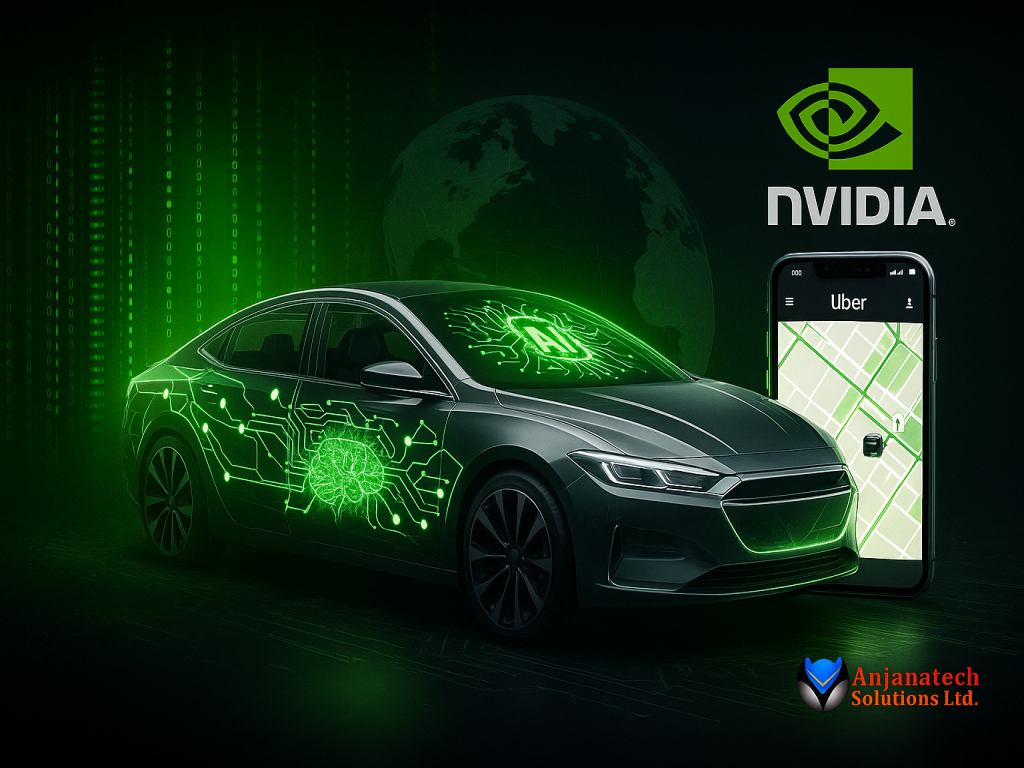
Imagine taking a ride in 2027 where you don’t see a driver — just a sleek black vehicle gliding through the streets, heading to pick you up. The car knows your identity, your destination, and it drives itself safely. This isn’t science fiction. It’s the promise behind NVIDIA’s new DRIVE AGX Hyperion 10 architecture — a platform described as making any vehicle “Level 4-ready”.
🧑💼 Who is NVIDIA?
NVIDIA Corporation is a leading US-based company known for graphics processing units (GPUs), AI hardware and software, and now autonomous vehicle (AV) platforms. Their technologies power everything from gaming to data centres to next-gen mobility.
🚗 What is DRIVE AGX Hyperion 10?
At a high level:
-
It is a reference compute and sensor architecture designed by NVIDIA to enable vehicle manufacturers and developers to build Level 4 autonomous vehicles — vehicles that can drive themselves in many conditions without human intervention. NVIDIA Investor Relations
-
Key features include dual DRIVE AGX Thor system-on-chip, a multimodal sensor suite (14 cameras, 9 radars, 1 lidar, 12 ultrasonics), and the DRIVE OS automotive operating system.
-
NVIDIA announced in October 2025 a partnership with Uber to deploy this architecture in close to 100,000 vehicles starting in 2027.
🏗 Why this matters for innovation & mobility
-
Acceleration of autonomous fleets: With a standard platform, OEMs can adopt, deployment of robotaxis, self-driving trucks, and delivery vehicles becomes more scalable.
-
Platform for “Physical AI”: Beyond self-driving, architectures like Hyperion aim to support advanced AI workloads — vision-language-action models, generative AI applied to sensor fusion and decision making.
-
Safety & Standards: NVIDIA’s specification includes production-grade safety and cybersecurity certifications (e.g., ISO standards), which are essential when vehicles gain autonomy.
-
Industrial impact: From logistics to ride-hailing to new mobility services, this kind of architecture lowers barriers to entry by providing a “platform” rather than each company building from scratch.
📅 Timeline & key milestones
-
January 2025: NVIDIA announced that its DRIVE Hyperion platform achieved automotive safety & cybersecurity milestones.
-
October 28, 2025: Official press release from NVIDIA: partnership with Uber, details of DRIVE AGX Hyperion 10 architecture, target of 100,000 vehicles.
-
2027 (planned): Launch scaling of robotaxi and autonomous fleets via Uber/NVIDIA.Read more on Digital Watch Observatory
⚠️ Some caveats & what to watch
-
Although Hyperion 10 is described as “reference production” and “level 4-ready”, that doesn’t guarantee immediate large-scale deployment or full driverless operations in all markets. The press release itself notes some “when-and-if-available” language.
-
Hardware and software integration in vehicles depends on OEMs, regulatory environments, infrastructure, and cost all aligning.
-
For emerging markets, adaptation, regulatory approval, local infrastructure (maps, sensors, connectivity) remain significant challenges.
🔍 What this means for Kenya / the broader tech ecosystem
-
If architectures like Hyperion pave the way for globally scaled autonomous mobility, African markets may eventually benefit from shared technology stacks, lower cost of innovation, and leap-frog mobility models.
-
Local tech-ecosystem players (startups in logistics, mobility services, sensor/data firms) may partner or adapt similar architectures for use in African-specific contexts (e.g., delivery fleets, urban mobility).
-
AI compute, sensor fusion, edge hardware – these become key enablers, meaning skillsets in Kenya and Africa for AI engineers, robotics, sensor analytics become increasingly valuable.
🧠 Final Thoughts
The announcement of NVIDIA DRIVE AGX Hyperion 10 and the Uber partnership is a milestone in autonomous mobility. While immediate deployment will take years and global markets have many hurdles, the shift toward software-defined, AI-powered vehicles is unmistakable.
For those in tech, startups, automotive, AI and mobility services — this architecture lays a foundation worth understanding and aligning with.
In short: yes — the post you saw is real, and yes, you can build a blog, discussion or business strategy around it. But keep expectations grounded: the future described is being built, not yet fully arrived.






No Comments yet. Be the First to Leave a Comment